Friday, 3 December 2010

Reverse Engineering - What the hell is it?

reverse engineering
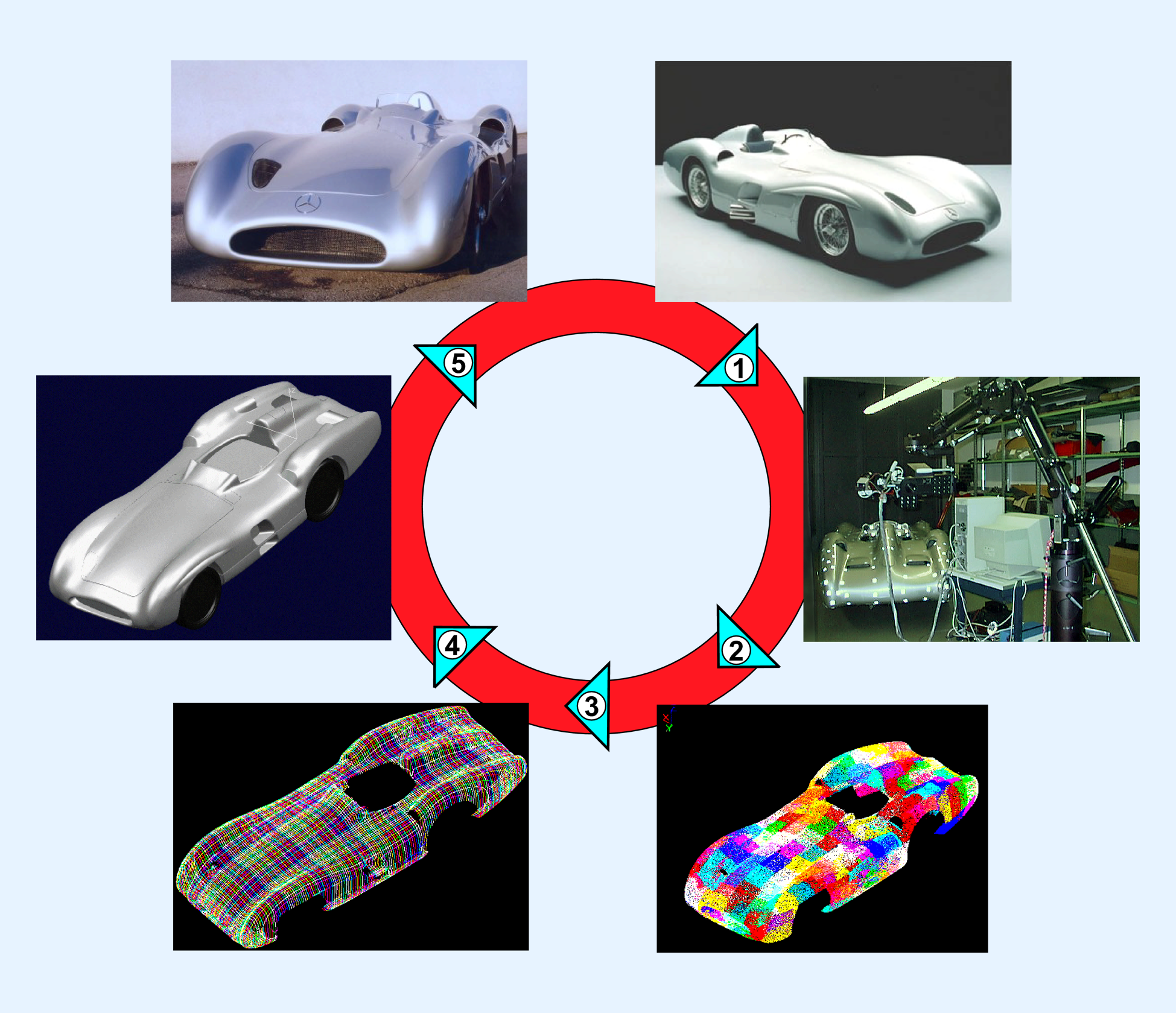
The clue is within the name with regards to reverse engineering. This is usually a procedure for determining the technical rules and mechanics of a apparatus or object by means of evaluating the structure, performance and operation.

Generally reverse engineering calls for scanning an item as a way to replicate a perfect 3-d replication. As a result, three dimensional scanning technologies also come straight into play, it may consist of both white light scanners, 3d scanners and CMMs.

Essentially an object or machine is taken and broken down layer by layer with every layer being analysed until the overall workings and function of the device is understood. Using this method an item could be remade or perhaps the original can even be enhanced.

The method of reverse engineering has been utilized quite a lot inside the military services. 1 of these cases is thestyle of the jerry can. During the Second WW the British military realized that the German’s jerry cans were of a superior design and build than their own. Consequently, they captureda few and utilised reverse engineering to discover the way they worked etc.

As jerry cans were really a German creation called Wehrmachtskanister, the Uk name ‘jerry can’ occurred given that they were taken from Jerrys (Germans).

There are several reasons why reverse engineering is a good idea. Such as product analysis, digital correction, military surveillance as well as foreducational functions. By working backwards you can easliy see how something performed when completed then go backwards to look at how this happens, rather than the conventional path of beginning with nothing and working up.

Reverse Engineering - What the hell is it?

reverse engineering
The clue is within the name with regards to reverse engineering. This is usually a procedure for determining the technical rules and mechanics of a apparatus or object by means of evaluating the structure, performance and operation.

Generally reverse engineering calls for scanning an item as a way to replicate a perfect 3-d replication. As a result, three dimensional scanning technologies also come straight into play, it may consist of both white light scanners, 3d scanners and CMMs.

Essentially an object or machine is taken and broken down layer by layer with every layer being analysed until the overall workings and function of the device is understood. Using this method an item could be remade or perhaps the original can even be enhanced.

The method of reverse engineering has been utilized quite a lot inside the military services. 1 of these cases is thestyle of the jerry can. During the Second WW the British military realized that the German’s jerry cans were of a superior design and build than their own. Consequently, they captureda few and utilised reverse engineering to discover the way they worked etc.

As jerry cans were really a German creation called Wehrmachtskanister, the Uk name ‘jerry can’ occurred given that they were taken from Jerrys (Germans).

There are several reasons why reverse engineering is a good idea. Such as product analysis, digital correction, military surveillance as well as foreducational functions. By working backwards you can easliy see how something performed when completed then go backwards to look at how this happens, rather than the conventional path of beginning with nothing and working up.

Monday, 22 November 2010

All you need to know about White Light Scanning

whitelightscanning
White light scanning, usually referred to as WLS, is a strategy utilized to precisely measure physical items which could be unable to be calculated by means of classical techniques like a plane part, a grave or even a face.

As soon as the item is scanned a wholly exact three-dimensional photo will be generated that measures every last little bit of the items surface. By way of example, if a sheet of paper is scanned, an object you would imagine is quite even and even; it'll be capable to present to you every one of the teeny tiny bumps and ridges on the surface.

You might imagine thatsuch a product would have to be enormous as a way to scan stuff including tombs although this is not true.White light scanning machines are in reality relatively small. For the reason thatthey have to becarried to varied locations and quite often shifted around fixed objects as a way to scan every single inch of the object.

Many of the purposes of white light scanners areextremely serious. Including when a plane crashes or breaks as a result of a component of its composition breaking or even a bird flying in the engine, a scanner can certainly multiply a perfect copy of the sizes of the first piece. Exactly the same may be applied to the racing car sector. When objects are travelling so speedily and every little thing will depend on how wind resistant they are this is important.

So you can see, white light scanning is definitely an exciting topic and it has enabled us to properly measure an incredible volume of otherwise immeasurable, opening the way to a whole list of potential ideas and developments.

Wednesday, 10 November 2010

What is a 3D Scanner?

A 3D Scanner analyses an object to collect information about its shape and appearance. This information once it has been collected can be used to make 3D Models.

Industries that use 3D Scanners:
3dscanner

-Movie and Video game production Industry
-Industrial Design
-Prosthetics
-Prototyping
-Reverse Engineering
-Quality Control

How 3D scanners work:

These types of scanners have a cone shaped field of view and can only collect information on unobstructed objects. The image produced by the scanner tells you the distance to a surface at every point. Usually an object has to be scanned from multiple angles, multiple times to get a well-rounded and accurate result. The images produced are the aligned and merged to create a final scan.

Different types of scanner:
3dscanner

Triangulation 3D Scanner- This type of scanner shines a laser on the subject of the scan. It is called a triangulation scanner because the laser dot, the lase emitter and the camera form a triangle.

Hand Held Laser- With this scanner a laser dot is shone on to the object from the hand held device and a sensor measures the distance to the surface.

Structured Light scanner- A structured light 3D Scanner projects a pattern of light on the object being scanned. A camera then looks at the distortion of the pattern to determine the objects shape. This type of scanner is very fast and can scan multiple points at any one time.

Modulated light 3D Scanner- Modulated light scanners shine a light at the object that continually changes. A camera then detects all reflected light. There is no interference with this type of scanner as it is able to ignore light from any source other than the scanner.

The application of 3D scanners:

Within the entertainments industry these scanners are used to create 3D models for movies and video games. Usually an artist sculpts a model which is then scanned and used. Scanners have been used to scan tombs so as to discern the size and shape of them. Many ancient artefacts have also been scanned. They can also be used in the medical sector, especially dentistry.
3D scanners are now widely used in many sectors and industries.

They are advancing rapidly along with many other types of technology. Many people and businesses are realising the potential of using 3D scanning techniques. There are lots of reputable companies out there that provide scanning services.

For more information see 3D Scanner

Monday, 1 November 2010

White Light Tooth whitening

whitelight
White light tooth whitening is becoming more and more popular. More people are aspiring to be like their favourite celebrities with wonderfully white teeth. Tooth whitening used to be something that only these celebrities and the extremely wealthy could afford but things have now progressed.

White light whitening has made beautiful teeth accessible to all. You can now buy kits from your dentist as well as over the internet. They are easy to use, cost effective and reliable.

How does it work?

The white light is used with a specially formulated gel. Used together they penetrate deep stains and clean your teeth thoroughly. This is a procedure that you perform at home for your ease, dignity and comfort. Other types of white light whitening can be done through a “whitening pen” which you squeeze to emit a gel and the rub it over your teeth.

What type of teeth does it work ok?
whitelight

- Combats signs of tooth ageing

- Smokers teeth

- White wine stained teeth

- Coffee stained teeth

Is it cost effective?

Dentists in the United Kingdom charge anything from £250 to £2000 for teeth whitening procedures. You can get home white light tooth whitening kits from upwards of £50.

How long does it take?

It only takes a few minutes to perform the procedure and results sometimes visible after the first application. Optimum results can be seen after using the pen twice a day for one whole week. You continue the process until you achieve the desired tooth whiteness. To maintain your desired whiteness you then complete the procedure once a month.

Teeth can usually be whitened by two to five shades through white light whitening procedures. The whitening usually lasts for a considerable amount of time. This of course will be hindered if you drink coffee, wine and also if you smoke.

Is it safe?

Many companies are now selling tooth whitening kits. If you are considering white light whitening then you are best to consult your dentist. They will be able to recommend a reputable product or brand and can also offer you advice on how best to move forward.

Many people have bought cheap kits, thinking they are getting a bargain but have ended up being stung. Some people have adverse reactions to these cheap treatments so it really is bets to pay a little extra. You do get what you pay for and it is better to be safe than sorry.

For more information see white light

Tuesday, 26 October 2010

What is Reverse Engineering?

reverse engineering
Reverse Engineering is a process that measures the technological values of an object or system through analysis function, structure and operation. Usually something will need to be taken apart for its internal working to be asses and analysed. The purpose of this type of engineering is to deduce how a product works without any prior knowledge on its construction.

To quote an expert “It is going backwards through a traditional development cycle”.

Why use reverse engineering?

It has many applications one of them being document recovery. If a document has been lost and is unable to be used as it is needed then reverse engineering can be applied. Another application if it is in product analysis. If a manufacturer stops producing a product then another manufacturer may want to start selling it and use reverse engineering to ascertain how it was made initially.

If a supplier refuses to supply new parts for a product then you could use this type of engineering to have new ones made by another company. You can use it to examine how well a product works, what it is made of and estimated costs. It has a fairly military background and has been used in espionage where a enemies devices have been stolen and dismantled to discover its inner most workings.

How does reverse engineering work?

The process starts with the item in question being measured and the re-created as a 3D model. Measurements are usually gleaned using white light scanners.

reverse engineering
Reverse engineering and the Military

As previously mentioned it is very often used by military forces of certain nations to copy other nation’s technologies and advancements. There are a couple of famous examples of reverse engineer that came out of the war.

• Jerry cans, as you may know, are petrol containers. The American and British forces noticed that the Germans had really well designed containers so they obtained one of these and reverse engineered it for their own use.
• B-29 Bombers were copied by the Russians after American Bombers were forced to land in Russia after a mission to Japan. Within a few years they had managed to develop a near perfect copy through reverse engineering.

Many industries use this form of engineering

Software engineering, automotive engineering, entertainment, microchips, chemicals, electronics, consumer products, and mechanical design are all sectors where this is used. Lead-times can be shortened by using reverse engineering which makes it an incredibly useful process.

For more information see reverse engineering

Tuesday, 19 October 2010

What is White Light Scanning?

whitelightscanning
White Light Scanning is a process that measures the geometrical characteristics of an object. A white Light Scanner is one of the most accurate tools for measuring 3D objects.

How does the scanner work?

The scanner sends multiple lights towards an object. As the lights hit the object something called “interference” occurs. Interference is defined as “Anything that alters, modifies or disrupts a signal as it travels along a channel between a source and a receiver”.

The differences between the lights are measured and the scanner formulates digital co-ordinates for the object that is being measured. The scanner compares all the different points of the object and the data stored acts as a 3D model which can be used with CAD (Computer Aided Design) software.

What are the benefits of White Light Scanning?

One of the first great things about it is that minimal set up is required. The system can either be worked by an operator or by pre-programing.

It is also a form of non-contact scanning which means that there is no danger of the object being damaged. Another couple of great things about White Light Scanning are that is extremely accurate and very fast. It also can be used on medium to large objects which widens the potential of what is able to be scanned.

Who uses White Light Scanning?

It is useful to many industries, one of the most successful being manufacturing. Dentistry is also another field where it is used. It has helped in surgery planning, training and constructing casts. The scanners also have a lot of applications in the Marine sector.

They can ensure that Yachts parts all fit together correctly and also help optimise a ships propeller performance.

Different Types of White Light Scanner
whitelightscanning

The Steinbichler COMET 5

The Steinbichler COMET 5 is a White Light Scanning Stystem. It provides high speed 3D Measuring and the 3D digitizing is also completed in a timely manner. It is an ideal scanner for a rigorous manufacturing industry or for use in product design.

The Steinbichler COMET Xs

This one is a compact 3D system for fast and easy measurement and inspection of small objects in quality control, reverse engineering, rapid design and manufacturing.

As you can see White Light Scanning is an extremely useful process and one that is used across the board. It is very efficient and accurate in every way.

For more information see White Light Scanning